Australia’s origin story has a few surprises in it
 Convicts. Gold. French spies. British money. And a country built around a plan most of us were never taught.
You know the standard version: Britain needed somewhere to send convicts, so it started a colony on the other side of the world. End of story.
But what if that’s only the short version?
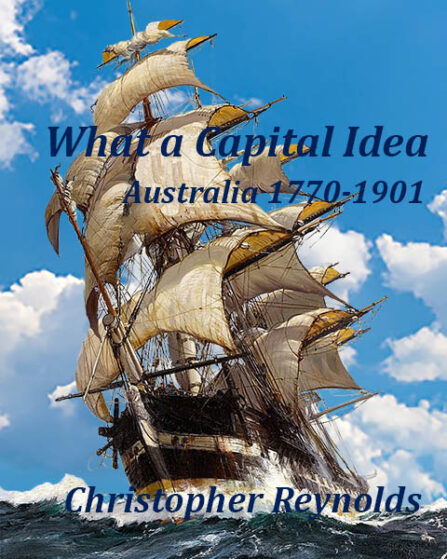
In What a Capital Idea – Australia 1770–1901, Dr Christopher Reynolds takes another look at who was making the big calls, what they stood to gain, and what was happening behind the official story. He follows the money, digs into original documents and asks the sort of questions that make you stop halfway through your beer and say, “Hang on—why didn’t we learn that?”
Reynolds argues that Britain’s plans for Australia were tied to trade, power and the fear that France might claim the continent first. The arrival of the First Fleet, in his telling, wasn’t just about transportation. It was part of a bigger geopolitical contest, with Australia sitting in a very useful spot on the map.
Then there’s the money. Gold discoveries helped turn the colonies into a commercial powerhouse. Reynolds calls Australia Britain’s “greatest commercial accident”: a project that became far more valuable than its planners could have expected. He traces how trade with Britain grew—and asks who made money, who made the decisions and how those choices shaped the country we live in now.
Some of the stories get wonderfully unexpected. Reynolds explores the case that Arthur Phillip had an intelligence role under Lord Sydney, and asks what Phillip’s salary and wealth tell us about the job of governing the new colony. There’s William Dampier, the pirate whose adventures ended with a fortune at sea; Napoleon, who reportedly wanted to join La Pérouse’s expedition as a teenager; and the first night of the colony, when convicts and marines celebrated together under the stars until a thunderstorm brought the party to an abrupt end. They’re the sort of details that make you look up from the page and say, “You’re kidding—why have I never heard that?”
The book also takes on some of Australia’s most familiar stories: what transportation was meant to achieve, how Aboriginal people featured in the debates around Federation, and whether becoming a republic is as simple as changing the flag or the head of state. Reynolds brings law, politics, economics and social history into the conversation, and challenges readers to test the usual version against the evidence he has found.
You don’t have to be a history buff to get into it. This is about the arguments that still matter: who owns the story, where the wealth came from, what sort of country we’ve become, and whether the lessons we were handed at school tell the whole tale.
And there’s plenty of book to get stuck into: 486 pages, around 300 paintings and photographs, and more than 20 character profiles. You can follow the big arguments, then meet some of the people caught up in them—governors, explorers, politicians, convicts and schemers. It’s a book to browse as well as read, with pictures and stories that give you plenty to point out around the kitchen table.
It can also be a useful book to keep within reach when a school assignment comes up. It brings together original documents, legislation and personal accounts, giving older students material to investigate and compare with what they’ve learned elsewhere. And when the assignment’s done, the same pages can spark a good yarn at home—or a lively argument down the pub.
At $80 for the hardcover, you’re getting a substantial, illustrated history you can keep, lend and come back to. You might agree with Reynolds. You might reckon he’s got some things wrong. Either way, you’ll have plenty to chew over—and a few things to bring up next time someone says, “Australia’s history is pretty straightforward, isn’t it?”
Read it. Make up your own mind. Then tell your mates what you found.
See video
Controversial, enlightening and exciting new book
What a Capital Idea – Australia 1770-1901 lifts the lid off the Australian story and exposes the myths. It is the most comprehensive and accurate record of Australian history ever published.
Author, Christopher Reynolds, explains: “What a Capital Idea is not just another history book that runs through the events of Australia’s history since settlement. I thoroughly investigate the reasons for political and commercial decisions – chasing down the money trail and looking for the context and people behind events like never before.”
Reynolds, uses his wide ranging knowledge to analyse original legislation, documents and personal accounts to reveal the political, social and economic forces that created and moulded Australia’s development. By exploring historical events from the perspectives of sociology, law, and political science, it is the breadth of perspective, the depth of consideration, and the focuses on economic development that makes this work unique. Indeed, at every turn, the research challenges the validity of the prevailing narrative of Australia’s history. Yet, the scholarship is tempered by an easy-to-read style that draws the reader on like a novel.
Some key references:
- Australia was not a penal settlement and ‘transportation’ was not a sentence by the courts for incarceration and punishment, but was intended to give people a ‘second chance’ at life.
- Aboriginal people voted along with everyone else in the referendums for Federation.
- Australia was Britain’s greatest commercial accident. When gold was discovered near Tamworth in 1852, shares in the Australian Agricultural Company sold on the London Stock Market for the equivalent of US$40,000 a share. By 1900 export trade from Australia to Britain reached some £90 million (US$13 billion at today’s value) – three times larger than Canada.
- Australia becoming a republic is an idealistic notion with little chance of eventuating because the Commonwealth of Australia is a political system of shared sovereignty. As a federation, the Commonwealth and States have sovereignty within their own spheres and continue to have independent relationships with the Crown.
Review this book: https://reynoldlearning.com/australian-history/