A Capital Idea, Two Visions: The long road to Federation
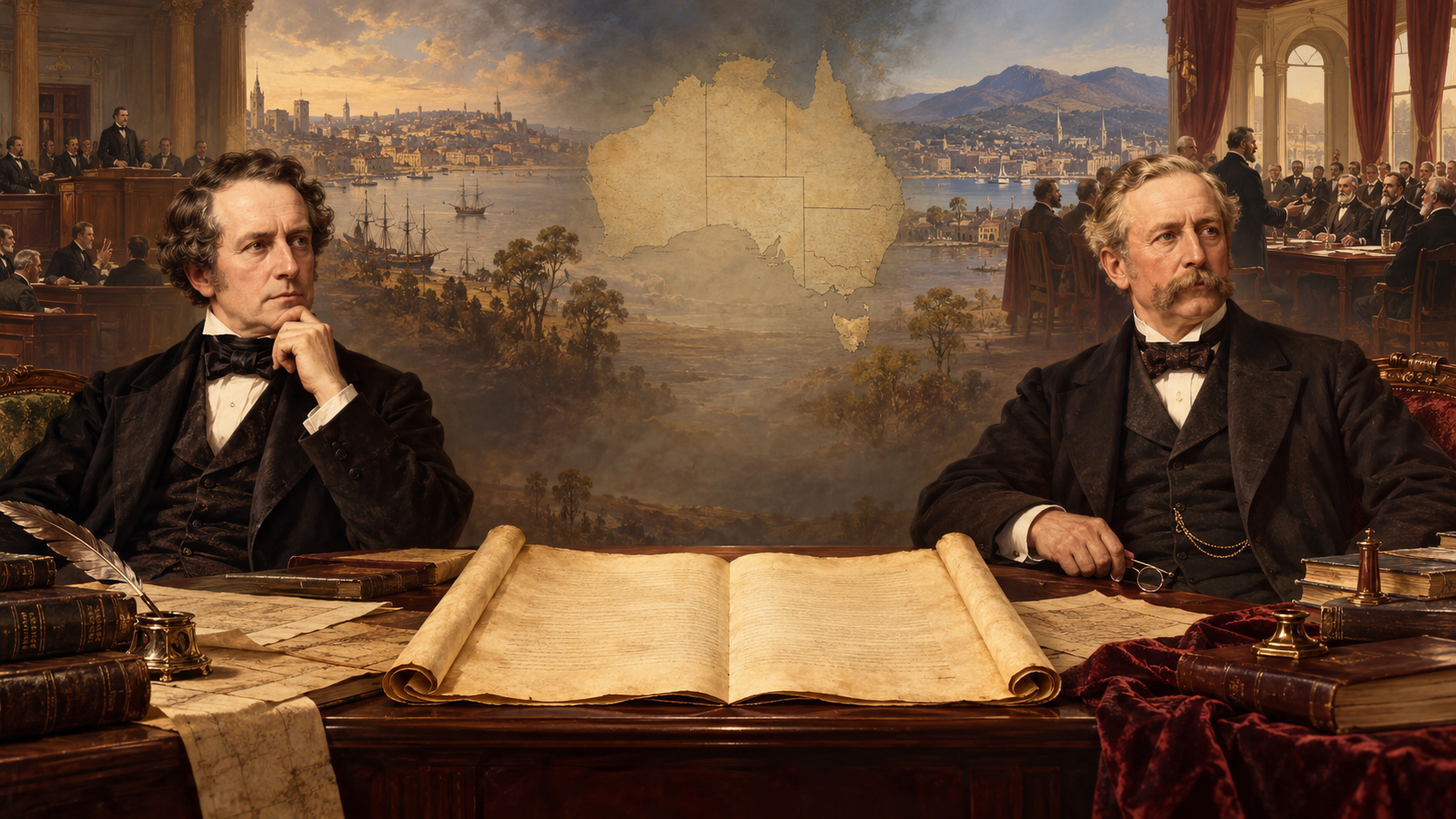
Concept artwork for this story. Wentworth and Clark belonged to different generations and never met.
What did self-government mean in colonial Australia, and what kind of federation should follow? From William Charles Wentworth’s campaigns in New South Wales to Andrew Inglis Clark’s constitutional work in Tasmania, the answers were argued over for generations.
Imagine opening a history book to find two Australians wrestling with the same big question from opposite ends of the nineteenth century: who should have the power to shape this country?
Wentworth and Clark never met. Wentworth died in 1872, when Clark was 24. Placing their stories side by side helps us compare two different moments in a much longer constitutional story.
Wentworth’s push for a colony that could govern itself
In the 1820s, Wentworth and his colleague Robert Wardell used the newspaper The Australian to challenge colonial authority and argue for a free press, trial by jury and representative government. In 1825, Wentworth helped frame a public address demanding those rights. His campaign formed part of a growing argument that people living in New South Wales should have a stronger say in how the colony was governed. The Australian Dictionary of Biography’s account of Wentworth traces that campaign through the colony’s changing political arrangements.
His story is more complicated than a simple march towards democracy. Wentworth sought greater colonial control over land and revenue, yet he also supported property-based restrictions on voting and proposed a hereditary upper house in the 1850s. Public opposition helped remove the hereditary principle from the constitution that followed. His career shows how a call for self-government could sit alongside the class assumptions of its age.
Clark’s draft—and the arguments that followed
By the 1890s, the debate had widened. The colonies were considering how to join together under a federal Constitution while retaining state governments. Clark brought a draft federal Constitution to the 1891 National Australasian Convention. Drawing on American, British and colonial models, his work helped provide a framework for discussion. It was influential, but the Constitution that came into force was shaped by many delegates and later negotiations. A parliamentary history of Clark’s contribution follows how the 1891 work fed into the later process.
Clark did not attend the 1897 convention, but continued to engage with the draft after returning to Tasmania. He introduced it in the Tasmanian parliament, remained uneasy about parts of the financial settlement and judiciary provisions, and sent amendments to the 1898 convention. This is not a story of one man writing a Constitution and then simply rejecting it. It is a story of a constitutional thinker contributing to a shared project while questioning its compromises. His Australian Dictionary of Biography entry records both his contribution and his reservations.
A national story with voices missing
The 1890s conventions were important, but they were not a gathering of all Australians. Women were not delegates—although Catherine Helen Spence stood unsuccessfully for election in 1897—and Aboriginal and Torres Strait Islander people were not represented. The Constitution that took effect in 1901 also contained provisions excluding First Nations people from the Commonwealth census and from certain Commonwealth powers. The Parliamentary Education Office, Parliament of Australia and AIATSIS explain this history.
That absence matters when telling the story today. Wentworth and Clark help us understand arguments among colonial political leaders, but their experience cannot stand in for every Australian experience of nation-making. Any wider screen project exploring First Nations histories, communities or cultural knowledge would need to involve the relevant people and cultural authorities early, with care and proper consultation.
From the page to a possible screen story
One proposal is to test this history in a short proof-of-concept film. Christopher Reynolds could provide historical voice and context, while documents, maps, archival material and carefully labelled visual reconstructions take viewers into the period. The script should determine the film’s length.
Before such a piece moves forward, key speeches and quotations need checking against primary sources, and archival images, music and other material need clear rights. Any AI-assisted reconstruction should be identified as interpretation, not presented as a photograph or record of an event. These steps help viewers see what is documented, what is reconstructed and what remains uncertain.
What a Capital Idea and Leaders ’n’ Larrikins offer readers a way to follow Australia’s arguments and personalities beyond one constitutional episode. A carefully made screen pilot could bring those stories to new audiences while testing whether the Wentworth–Clark question holds attention beyond the page.
Federation was not the work of one speech, one draft or one day. The Constitution was passed by the British Parliament in 1900 and came into effect on 1 January 1901, after conventions, public votes and negotiations among the colonies. The Parliament of Australia’s Federation guide sets out that sequence.
The long road to Federation leaves us with a question that still feels alive: when people share a country, how should they share power—and whose voices must be heard when the rules are written?
Meet Dr. Christopher Reynolds, an extraordinary Aussie who's done it all—from working with President Ronald Reagan to running the Sydney World Trade Centre. His book, *What a Capital Idea*, takes you on an exciting journey through Australia’s history, focusing on how money and political maneuvers shaped the nation between 1770 and 1901.
At 500 pages, it’s packed with engaging stories that make history fun and relatable. Imagine having a chat with a wise friend who cracks jokes while debunking common myths. Dr. Reynolds inspires you to view Australia with fresh eyes and feel hopeful about the future.
Dive into *What a Capital Idea* and get ready to explore a new perspective on your country’s past—it might just ignite your own dreams for the future!